We have continued learning about plants this week. On Wednesday we looked some fruits and we saw if they had seeds or not . Then, we counted how many seeds they had.
We completed a chart with some information about these fruits. There were an odd one out that was the artichoke, since it is a vegetable instead of a fruit.
The checked out fruits were: lemon, tangerine, tomato, banana and apple.
--------
Hemos seguido aprendiendo sobre las plantas esta semana. El miércoles miramos algunas frutas y vimos si tenían semillas o no y cuántas tenían.
Completamos una tabla con información de estas frutas. Había un intruso, que era la alcachofa, ya que es una verdura, en lugar de una fruta.
Los frutos examinados fueron: limón, mandarina, tomate, plátano y manzana.
We also played a TRUE/FALSE game to review some contents of the unit.
-----
También jugamos a VERDADERO/FALSO para repasar algunos contenidos de la unidad.
Finally, on Thurday we went to our playground to look for different types of leaves in order to classify them after that. We found two different types: one from a tree and one from a bush.
------------
Finalmente, el jueves fuimos al patio a buscar distintos tipos de hojas para clasificarlas después. Encontramos dos tipos diferentes: una de un árbol y otra de un arbusto.
One of the most difficult things in English are the sounds, which are completely different from Spanish language. For that reason, we have started learning English sounds.
In every unit, we will learn a new sound, and we'll put together the new and previous sounds we are learning.
-------
Una de las cosas más difíciles en inglés son los sonidos, que son completamente diferentes del español. Por eso, estamos aprendiendo los sonidos en inglés.
En cada unidad, aprenderemos un nuevo sonido, y pondremos en práctica los nuevos sonidos con los ya aprendidos.
---------
We
practised the sounds with the following activities and games:
Firstly, we
listened to the songs of the sounds and then, we practised the gesture of each
sound in an isolated way.
-----
Hemos practicado los sonidos con las siguientes actividades y juegos:
Primero, hemos escuchado las canciones de los sonidos y después hemos practicado el gesto de cada sonido.
Then, we
listened to the story of the sounds and we did a list with words we know with
those sounds.
-------
Luego esuchamos la historia de cada uno de los sonidos e hicimos una lista de palabras que conocemos con cada uno de esos sonidos.
After that
we played a game, where children had to touch the letter of the sound they heard
in the first round; the gesture in the second round and the word with that
sound in the third round.
------
Después, jugamos a un juego, donde los niños tenían que tocar en la letra del sonido que ellos escucharan en la primera ronda; el gesto en la segunda ronda y en la tercera ronda escuchaban una palabra.
After that,
we made a gesture dictation: the teacher made gestures of some sounds and they
had to write the word down.
-----
Después de eso, hicimos un dictado de gestos: la maestra hacía los gestos de los soniños y los alumnos tenían que escribir la palabra.
We also
ordered some sounds to read the nonsense words.
----
También ordenamos algunos sonidos para hacer palabras absurdas y leerlas.
Finally, we
classified some objects according to their beginning sounds.
----
Por último, clasificamos algunos objetos teniendo en cuenta el sonido inicial de la palabra de cada objeto.
This week we reviewed the verb 'have got' and pets. We practiced these contents by means of a game. In pairs, each child had a card and his classmate had to ask him if he had this animal or not.
-------
Esta semana hemos repasado el verbo 'tener' y las mascotas. Hemos practicado estos contenidos con un juego. En parejas, cada niño tenía una tarjeta y su compañero tení que preguntarle si tenía esa animal o no.
In year 2, students have learnt some parts of the house: bedroom, bathroom, hall, garage, kitchen, living room, dining room and toilet.
Besides, this course they have to learn some prepositions: on, in, under and behind.
For reviewing them, we did the following activity. In pairs, children came to the board and they asked where a member of a family was. The structure was:
- Where is...?
- He/She is in the…
-------------
En segundo, los niños han aprendido algunas partes de la casa: dormitorio, baño, entrada, garaje, cocina, sala de estar, comedor y aseo.
Además, este curso tienen que aprender algunas preposiciones: encima, dentro, debajo y detrás.
Para repasarlas, hicimos la siguiente actividad.En parejas, los niños salían a la pizarra y preguntaba dónde estaba un miembro de una familia.La estructura era:
- Dónde está...? - Él / Ella está en el …
Then, for working on prepositions we played a game, also in pairs.
One student had a card with the name of a preposition and he or she had to do the action that the preposition required. The other one, had to guess the preposition, making a correct sentence.
--------------
Luego, para trabajar en preposiciones jugamos a un juego, también en parejas.
Un estudiante tenía una tarjeta con el nombre de una preposición y tenía que hacer la acción que requería la preposición.El otro, tenía que adivinar la preposición, haciendo una oración correcta.
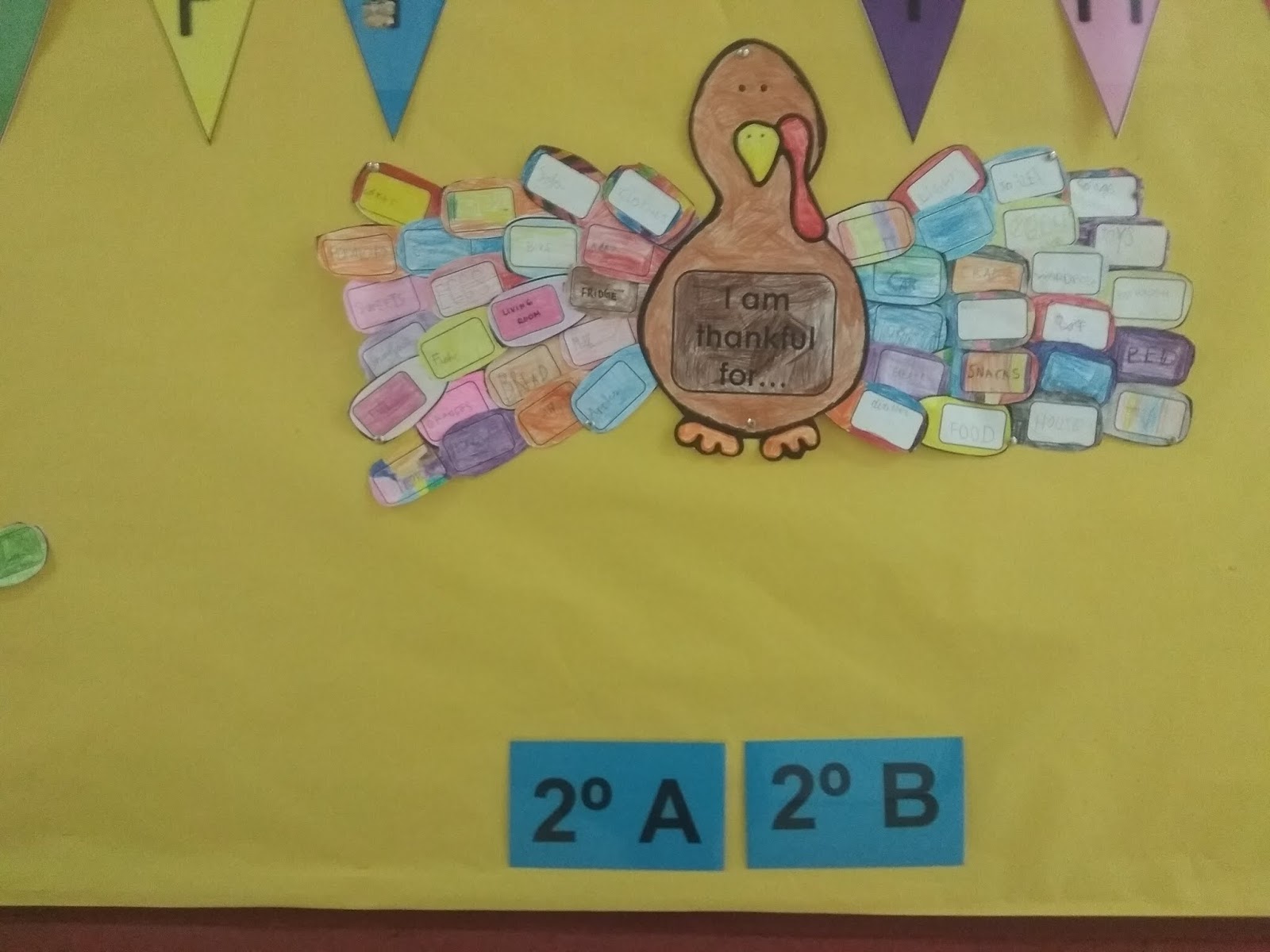
Last week, we celebrated Thanksgiving in our school.
Jasmine, our conversation auxiliary, told us a little bit about this festivity and, after that, each student wrote a word related to the worked vocabulary in classroom, on a feather, giving thanks for that.
Then, we sticked each feather on a big turkey. These turkeys are decorating our corridors.
This is the result.
-------------------
La semana pasada celebramos acción de gracias en nuestro cole.
Jasmine, nuestra auxiliar de conversación, nos contó un poco sobre esta festividad y, después de eso, cada niño escribió una palabra relacionada con el vocabulario trabajado en clase, en una pluma, dando gracias por ello.
Luego, pegamos cada pluma en un pavo grande. Estos pavos están decorando nuestros pasillos.
On Monday, we went to the theatre to watch the play of the story "Hansel and Gretel". Last week, Jasmine told us the story to know it before we watch it.
----------------
El lunes fuimos al teatro a ver la obra "Hansel y Gretel". La semana pasada, Jasmine nos contó el cuento para conocerlo antes de ir a ver la obra al teatro.